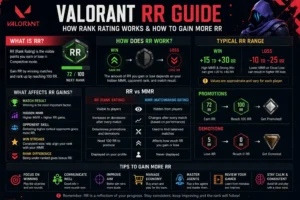
Valorant RR Guide 2026: How Rank Rating Works and How to Gain More RR
If you’ve ever finished a ranked match and wondered why you gained 28 RR or lost 18 RR, you’re not alone. Rank Rating, commonly known as RR, is one of the most important parts of Valorant’s competitive system, yet it’s also one of the most misunderstood.
Every ranked match affects your RR. Winning usually increases it, while losing decreases it. However, the amount of RR you gain or lose isn’t the same for every player. Your hidden Matchmaking Rating (MMR), the strength of your opponents, and your recent performance all play a role in determining your progress.
Understanding how RR works can help you rank up faster and avoid common mistakes that slow your climb. Instead of focusing only on winning individual matches, you’ll learn how Riot Games rewards consistent improvement over time.
In this guide, we’ll explain everything you need to know about Valorant RR, including how Rank Rating works, what affects RR gains and losses, how promotions and demotions happen, and the best strategies to climb the ranked ladder in 2026.
What Is RR in Valorant?
RR stands for Rank Rating. It is the visible point system used in Valorant’s Competitive mode to track your progress within each rank.
Every rank, from Iron to Immortal, is divided into three divisions. As you win matches, you earn RR. As you lose matches, you lose RR.
Once you reach 100 RR, you are usually promoted to the next division or rank. If your RR falls below zero after repeated losses, you may be demoted.
Unlike your hidden Matchmaking Rating, RR is visible on your profile after every competitive game. This allows players to see exactly how close they are to ranking up or dropping to a lower division.
Think of RR as your visible progress bar. Every competitive match moves that bar forward or backward depending on the outcome.
How Does Valorant RR Work?
Rank Rating is based primarily on winning and losing matches, but Riot’s ranking system also considers your hidden Matchmaking Rating (MMR).
If your MMR is higher than your current rank, the system believes you belong in a higher division. As a result, you’ll often gain more RR for victories and lose less RR after defeats.
If your MMR is lower than your visible rank, the opposite happens. You may notice smaller RR gains after wins and larger RR losses after defeats until your rank better reflects your actual skill level.
This system helps ensure that players eventually reach the rank that matches their long-term performance rather than a short winning streak.
Several factors influence your RR after each match:
- Whether your team won or lost.
- Your hidden Matchmaking Rating (MMR).
- The average skill level of both teams.
- Your recent ranked performance.
- Your current rank.
At lower ranks, individual performance can have a slightly greater impact. At higher ranks such as Immortal and Radiant, match results become the most important factor.
How Much RR Do You Gain Per Win?
One of the most common questions players ask is how much RR they should expect after winning a match.
There isn’t a fixed number because Valorant adjusts RR based on your hidden MMR and matchmaking.
Most players typically receive:
| Match Result | Typical RR Change |
|---|---|
| Win | +15 to +30 RR |
| Strong Win with High MMR | +30 to +40 RR |
| Loss | -10 to -25 RR |
These values are only estimates. Your actual RR gains may be higher or lower depending on your account’s hidden rating.
For example, if you’re consistently defeating opponents with a higher average MMR, the game may reward you with larger RR gains because it believes you’re ready for a higher rank.
On the other hand, if you’re losing frequently against lower-ranked opponents, your RR gains may decrease until your visible rank matches your hidden skill level.
What Affects RR Gains?
Many players assume RR depends only on kills, but Riot’s ranking system is much more complex.
Several factors determine how much RR you earn after each game.
Winning the Match
Winning is the biggest factor.
Even if you don’t finish at the top of the scoreboard, a victory is far more valuable than impressive individual statistics in a losing effort.
Hidden Matchmaking Rating (MMR)
MMR has the greatest long-term impact on RR.
Players with a higher hidden MMR often receive larger RR gains because the system believes they deserve a higher rank.
Opponent Skill Level
Defeating stronger opponents generally results in better RR rewards than defeating weaker teams.
Likewise, losing against significantly lower-rated opponents can reduce your RR more than expected.
Consistency
Winning consistently over many matches allows the ranking system to adjust your visible rank more quickly.
A single good game won’t dramatically change your RR, but maintaining a strong win rate over time usually leads to faster progression.
Current Rank
At lower ranks, your individual performance may slightly influence RR gains. As you climb into higher ranks, teamwork and match results become much more important than personal statistics.
Understanding these factors helps explain why two players can win the same match but receive different amounts of RR.
RR vs MMR: What’s the Difference?
Many Valorant players confuse Rank Rating (RR) with Matchmaking Rating (MMR). While they work together, they serve different purposes.
RR is the number you can see after every competitive match. It shows your progress toward the next rank and determines when you are promoted or demoted.
MMR, on the other hand, is completely hidden. Riot Games uses it to estimate your actual skill level and create balanced matches. Even though you cannot see your MMR, it has a major impact on how much RR you gain or lose.
The table below highlights the key differences.
| Rank Rating (RR) | Matchmaking Rating (MMR) |
|---|---|
| Visible to players | Hidden from players |
| Increases or decreases after every ranked match | Updates continuously based on long-term performance |
| Determines promotions and demotions | Determines matchmaking quality |
| Requires 100 RR for promotion | Used to calculate RR gains and losses |
| Displayed on your profile | Never displayed by Riot |
Imagine two Gold players.
The first player has a hidden MMR similar to Platinum players. The second player has an MMR closer to Silver.
Although both have the same visible rank, the first player will usually gain more RR after victories and lose less RR after defeats. The second player may experience the opposite until their visible rank matches their hidden MMR.
This system helps keep the ranked ladder fair and prevents players from staying in ranks that no longer reflect their skill.
How Promotions Work
Ranking up in Valorant is straightforward once you understand how RR is calculated.
Each division requires 100 RR to advance.
For example:
- Silver 1 → Silver 2
- Gold 2 → Gold 3
- Platinum 3 → Diamond 1
Once you reach 100 RR, you’ll usually be promoted immediately after your winning match.
After promotion, your RR resets within the new division, allowing you to continue climbing toward the next milestone.
Higher ranks become increasingly competitive because every promotion places you against stronger opponents with better mechanics, communication, and game knowledge.
How Demotions Work
Just as players can rank up, they can also move down after losing enough RR.
A demotion usually happens when:
- Your RR reaches zero.
- You lose another ranked match.
- Your hidden MMR continues to fall.
Riot includes limited demotion protection in certain situations, but consistently losing matches will eventually lower your rank.
Demotions should not be viewed as failures. Many players temporarily lose a rank before improving and climbing higher than before.
The ranking system is designed to place you where your current performance is most competitive.
Why Am I Gaining Less RR Than My Friends?
This is one of the most frequently asked questions in the Valorant community.
Two players can win the same match yet receive different amounts of RR.
The most common reasons include:
Your Hidden MMR Is Lower
If your hidden MMR is below your visible rank, the system believes you are currently ranked too high.
As a result, you’ll often gain fewer RR points after victories and lose more after defeats.
Recent Losing Streaks
Several consecutive losses can lower your hidden MMR, reducing future RR gains until your performance improves.
Easier Opponents
Defeating teams with a lower average MMR usually provides smaller RR rewards than defeating stronger opponents.
Inconsistent Performance
Winning one match and losing the next repeatedly slows your progress.
Players who maintain a positive win rate over dozens of matches generally climb much faster.
Does Performance Affect RR?
Yes, but only to a certain extent.
In lower ranks such as Iron, Bronze, Silver, and Gold, strong individual performances may provide slightly better RR gains.
Examples include:
- High combat score.
- Effective utility usage.
- Multiple first eliminations.
- Consistent impact throughout the match.
As you climb into Diamond, Ascendant, Immortal, and Radiant, match results become much more important than individual statistics.
Winning rounds as a team always matters more than chasing kills.
Can You Skip Ranks?
Yes, but it doesn’t happen often.
If your hidden MMR is significantly higher than your current rank, Riot’s ranking system may allow you to skip a division after promotion.
For example, a player who consistently dominates Gold lobbies while maintaining a Platinum-level MMR could occasionally jump directly into a higher division.
This usually happens only after a long period of excellent performance.
Most players should expect to climb one division at a time through consistent victories.
Common RR Myths
There are many misconceptions about Valorant’s ranking system. Understanding the truth helps players focus on the factors that actually improve their rank.
Myth: Getting MVP Guarantees More RR
Reality:
Being Match MVP is helpful, but winning the match is far more important than finishing with the highest number of eliminations.
Myth: Kills Are Everything
Reality:
Kills matter, but teamwork, objective play, communication, and winning rounds have a much greater impact on long-term rank progression.
Myth: You Need to Carry Every Match
Reality:
Valorant is a team-based tactical shooter. Supporting teammates with utility, trading kills, and making smart decisions often contributes more to winning than individual highlights.
Myth: Playing More Matches Always Means Faster Ranking
Reality:
Quality is more important than quantity.
Playing while tired or frustrated often leads to unnecessary losses that reduce both RR and hidden MMR.
A focused session of a few high-quality matches is usually more productive than playing for hours without concentration.
10 Tips to Gain More RR in Valorant
Climbing the ranked ladder isn’t about winning one great match. It’s about performing consistently over time. These tips can help you improve your gameplay and earn RR more reliably.
1. Focus on Winning, Not Just Kills
Many players chase eliminations instead of playing the objective. Winning the match has the biggest impact on your RR, so prioritize teamwork, spike control, and smart decisions.
2. Master a Small Agent Pool
Playing every agent makes it difficult to develop consistent skills.
Choose two or three agents that suit your playstyle and learn:
- Their abilities.
- Common lineups.
- Best maps.
- Team compositions.
Specializing will improve your decision-making and overall impact.
3. Improve Your Aim Every Day
Good mechanics win duels.
Spend 15 to 20 minutes warming up before ranked by practicing:
- Crosshair placement.
- Flick shots.
- Tracking.
- Recoil control.
Consistent practice often leads to more confidence during competitive matches.
4. Communicate with Your Team
Clear communication wins rounds.
Share information about:
- Enemy locations.
- Utility usage.
- Rotations.
- Spike position.
- Ultimate availability.
Simple callouts help your teammates make better decisions.
5. Learn Economy Management
Buying the right weapons at the right time is an important part of competitive Valorant.
Understand when to:
- Save credits.
- Force buy.
- Full buy.
- Purchase utility.
A strong team economy increases your chances of winning multiple rounds in a row.
6. Review Your Matches
After a difficult game, watch the replay or think through key rounds.
Ask yourself:
- Did I peek too early?
- Was my positioning correct?
- Did I use my abilities effectively?
- Could I have traded a teammate?
Learning from mistakes is one of the fastest ways to improve.
7. Stop Playing When You’re Tilted
Playing while frustrated often leads to poor decisions.
If you lose several matches in a row, take a short break before queuing again. Returning with a clear mindset usually produces better results.
8. Play with a Reliable Duo
A trusted teammate improves communication and teamwork.
A good duo can:
- Trade kills consistently.
- Coordinate utility.
- Make better strategic decisions.
- Reduce the impact of random teammates.
9. Stay Consistent
Improvement doesn’t happen overnight.
Focus on maintaining a positive win rate over many matches instead of worrying about a single loss.
Small improvements made every day lead to steady rank progression.
10. Keep Learning
Watch high-ranked players, study professional matches, and stay updated on game patches.
The competitive meta changes regularly, and adapting quickly gives you an advantage over other players.
Common Mistakes That Cost You RR
Many players lose Rank Rating because of habits they don’t even notice.
Avoid these common mistakes:
- Playing too many different agents.
- Ignoring communication.
- Taking unnecessary fights.
- Reloading immediately after every kill.
- Using abilities without a plan.
- Chasing kills instead of playing the objective.
- Continuing to play after multiple losses.
- Blaming teammates instead of reviewing your own gameplay.
Fixing just a few of these mistakes can make a noticeable difference over the course of a season.
Frequently Asked Questions
What does RR mean in Valorant?
RR stands for Rank Rating. It is the visible point system that determines your progress through Valorant’s competitive ranks.
How much RR do you gain after a win?
Most players gain between 15 and 30 RR for a victory. The exact amount depends on your hidden MMR, the strength of your opponents, and your current rank.
Why do I lose more RR than I gain?
This usually happens when your hidden MMR is lower than your visible rank. Riot’s system is trying to align your displayed rank with your actual skill level.
Can I skip ranks in Valorant?
Yes. Players with a much higher hidden MMR than their current rank may occasionally skip a division after promotion, although this is uncommon.
Does Match MVP give more RR?
A strong individual performance can help at lower ranks, but winning the match has a much greater impact on RR than earning Match MVP.
Is RR the same as MMR?
No. RR is the visible ranking system, while MMR is a hidden skill rating used for matchmaking and calculating RR gains.
How can I earn more RR consistently?
The best way is to maintain a positive win rate, improve your mechanics, communicate with your team, and play consistently over a long period.
Final Thoughts
Understanding how Valorant RR works gives you a significant advantage in competitive play. Instead of focusing only on the number displayed after each match, pay attention to the habits that lead to long-term improvement.
Winning consistently, communicating with your team, mastering a small pool of agents, and learning from your mistakes will naturally increase both your hidden MMR and your visible Rank Rating.
Every player experiences winning streaks and losing streaks. The difference between players who stay stuck and players who continue climbing is consistency. Focus on improving one aspect of your gameplay each week, and your rank will follow.
If you’re aiming to reach your desired rank faster, you can also explore our Valorant Rank Boost, Valorant Duo Boost, Valorant Placement Matches, and Valorant Coaching services. Whether you’re trying to break into Platinum, Diamond, Ascendant, or beyond, having experienced players by your side can help you achieve your goals while learning valuable strategies for future seasons.