 Valorant Rank Distribution 2026: Full Rank Percentages Guide
Valorant is one of the most competitive tactical shooters in the world. Millions of players queue for ranked matches every day with one goal in mind: climbing the competitive ladder. Whether you’re aiming for Gold, Diamond, or the prestigious Radiant rank, understanding the Valorant Rank Distribution can help you measure your progress and set realistic goals.
The Valorant Rank Distribution shows how players are spread across each competitive rank. It answers questions such as how many players reach Platinum, whether Diamond is considered above average, and how exclusive Immortal and Radiant really are. Many players use this information to compare their performance with the rest of the community and identify the next milestone in their ranked journey.
Your rank is more than a badge displayed on your profile. It reflects your consistency, teamwork, mechanical skill, decision-making, and ability to adapt during competitive matches. While every player starts somewhere, the distribution reveals that only a small percentage reach the highest tiers.
In this guide, you’ll learn how the Valorant ranking system works, the latest rank distribution, what each rank represents, and what you can do to improve your chances of climbing. Whether you’re a new player or an experienced competitor, understanding the competitive ladder will help you focus on the skills that matter most.
What Is Valorant Rank Distribution?
Valorant Rank Distribution refers to the percentage of players occupying each competitive rank. Riot Games uses this data to maintain a balanced matchmaking system and ensure players compete against opponents with similar skill levels.
The distribution changes throughout every Episode and Act. New players enter ranked, experienced players improve, balance updates affect gameplay, and seasonal rank resets move players around the ladder. Because of these factors, the percentage of players in each rank is never fixed.
Looking at the distribution helps answer several important questions.
- Is your current rank above or below average?
- How difficult is it to reach Diamond or Ascendant?
- How rare is Radiant?
- What ranks contain the largest portion of the player base?
These insights help players understand where they stand and set achievable goals instead of comparing themselves only with professional players or content creators.
How the Valorant Ranking System Works
Before understanding the rank distribution, it’s important to know how Valorant determines your competitive rank.
Every competitive player has two values working together.
Matchmaking Rating (MMR)
MMR is a hidden rating that estimates your actual skill level. Riot uses this value to create balanced matches, even if your visible rank doesn’t perfectly reflect your current performance.
Winning consistently against stronger opponents usually increases your hidden MMR, while repeated losses can lower it.
Rank Rating (RR)
Rank Rating, commonly called RR, is the visible point system players earn or lose after competitive matches.
Winning games grants RR.
Losing games removes RR.
When you reach 100 RR, you usually promote to the next rank. Falling below zero RR after enough losses may result in demotion.
Although RR is visible, MMR has a greater influence on matchmaking quality and future RR gains.
All Valorant Competitive Ranks
Valorant currently features nine main competitive ranks. Most ranks are divided into three tiers, with Rank 1 being the lowest and Rank 3 being the highest before promotion.
The complete rank order is:
- Iron
- Bronze
- Silver
- Gold
- Platinum
- Diamond
- Ascendant
- Immortal
- Radiant
Each rank represents a different level of game knowledge, communication, mechanical skill, and consistency.
As players climb higher, matches become significantly more demanding. Small mistakes that might go unpunished in Silver are often enough to lose rounds in Ascendant or Immortal.
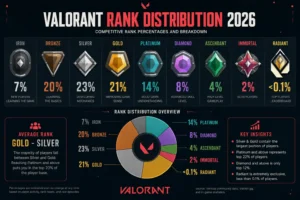
Valorant Rank Distribution 2026
While the exact percentages change throughout each competitive season, the following distribution represents the general spread of players across the ranked ladder.
| Rank | Estimated Player Percentage |
|---|---|
| Iron | 7% |
| Bronze | 20% |
| Silver | 23% |
| Gold | 21% |
| Platinum | 14% |
| Diamond | 8% |
| Ascendant | 4% |
| Immortal | 2% |
| Radiant | Less than 0.1% |
Several important trends stand out.
Silver and Gold contain the largest share of the player base. This makes them the most common ranks for active competitive players.
Platinum represents the point where players begin demonstrating above-average consistency in aim, positioning, and teamwork.
Diamond and Ascendant contain a much smaller percentage of players, making them significant milestones for anyone looking to prove their competitive ability.
Immortal is reserved for highly skilled players who consistently perform at an advanced level, while Radiant is limited to the very best players in each region.
Remember that these numbers shift over time as players improve, new Episodes launch, and Riot adjusts the competitive ecosystem.
What Is the Average Valorant Rank?
One of the most common questions players ask is whether they are above or below average.
The answer depends on the current competitive season, but in most Episodes, the average player falls somewhere between Silver and Gold.
If you are currently in:
Iron or Bronze
You’re still developing the core skills required for competitive play. This is where players build their understanding of maps, crosshair placement, movement, and agent abilities.
Silver
Silver players have learned the fundamentals but often struggle with consistency. This rank includes a large portion of the community and serves as a stepping stone toward more advanced gameplay.
Gold
Gold is generally considered the beginning of above-average performance. Players here show stronger mechanics, better communication, and improved decision-making compared to lower ranks.
Platinum
Platinum players consistently understand game fundamentals and can punish common mistakes. Reaching Platinum places you ahead of a large percentage of the player base.
Diamond and Above
Diamond, Ascendant, Immortal, and Radiant represent the highest levels of competitive play. Players in these ranks demonstrate excellent mechanics, teamwork, utility usage, and game sense. Every match becomes more demanding, requiring constant improvement to continue climbing.
Instead of focusing only on the badge next to your name, compare your current performance with your previous seasons. Consistent improvement is a better indicator of progress than a single promotion.
Why Does Rank Distribution Matter?
Understanding the Valorant Rank Distribution helps players set realistic expectations and track long-term improvement.
Many players assume they should reach Diamond within a few weeks of playing ranked. In reality, only a relatively small percentage of the community reaches that level.
Knowing where most players are ranked can help you:
- Set realistic improvement goals.
- Measure your progress over multiple Episodes.
- Understand how competitive each rank really is.
- Stay motivated even when climbing becomes difficult.
- Focus on developing skills instead of chasing short-term results.
The distribution also highlights how balanced Valorant’s matchmaking system is. Every rank contains players with similar skill levels, making matches competitive and rewarding for those who continue to improve.
Every Valorant Rank Explained
Every rank in Valorant represents a different stage of player development. While mechanical skill is important, climbing the ladder also requires good communication, game sense, positioning, and teamwork. Understanding what separates each rank can help you identify the areas that need the most improvement.
Iron
Iron is the starting point of the competitive ladder. Most players in this rank are new to tactical shooters or have only recently started playing Valorant.
Common characteristics include inconsistent aim, limited map knowledge, poor crosshair placement, and difficulty managing abilities. Many players also struggle with movement and often peek dangerous angles without a plan.
How to Get Out of Iron
Improving in Iron is usually straightforward because basic fundamentals make a huge difference.
Focus on:
- Keeping your crosshair at head level.
- Learning every map layout.
- Practicing your aim for 15 to 20 minutes before ranked matches.
- Playing only one or two agents until you master their abilities.
- Avoiding unnecessary fights.
Players who consistently improve these fundamentals often climb into Bronze quickly.
Bronze
Bronze players have a better understanding of the game but still make many avoidable mistakes. Communication begins to improve, but teamwork is often inconsistent.
Many Bronze players rely too much on aim while ignoring positioning and utility usage.
How to Reach Silver
To move beyond Bronze:
- Learn proper economy management.
- Stop reloading after every fight.
- Trade kills with teammates.
- Use abilities to create advantages instead of saving them.
- Review your deaths after each match.
Developing good habits at this stage creates a strong foundation for future ranks.
Silver
Silver is one of the largest ranks in the game. Players generally understand the basics but struggle with consistency.
Some matches feel easy, while others become difficult because players often repeat the same mistakes under pressure.
Typical Silver players:
- Have decent mechanics.
- Understand agent abilities.
- Make poor rotations.
- Lose focus during long matches.
- Take unnecessary risks.
How to Reach Gold
To climb out of Silver:
- Improve communication.
- Learn common defensive and attacking setups.
- Watch your own replays to identify repeated mistakes.
- Master utility timing.
- Stay patient instead of forcing fights.
Consistency becomes more valuable than raw aim.
Gold
Gold is considered an above-average rank. Players usually have solid mechanics and understand the objectives of each round.
However, many Gold players struggle with decision-making during stressful situations.
Examples include:
- Chasing unnecessary kills.
- Overextending after winning a duel.
- Ignoring teammates.
- Misusing ultimate abilities.
How to Reach Platinum
Improving from Gold requires smarter gameplay.
Focus on:
- Trading teammates whenever possible.
- Learning lineups if your agent benefits from them.
- Improving positioning after getting a kill.
- Playing around your team’s economy.
- Rotating earlier based on information.
Small improvements have a noticeable impact at this level.
Platinum
Platinum players demonstrate consistent mechanics and a strong understanding of Valorant’s core systems.
Matches become faster, communication improves, and players punish mistakes much more effectively.
Successful Platinum players usually:
- Clear angles carefully.
- Coordinate utility.
- Control map space.
- Understand timing.
- Adapt to opponents.
How to Reach Diamond
To continue climbing:
- Review lost rounds instead of focusing only on losses.
- Improve movement while shooting.
- Learn advanced utility combinations.
- Communicate every piece of useful information.
- Develop stronger mental discipline.
Winning close rounds often separates Diamond players from Platinum players.
Diamond
Diamond is where competitive gameplay becomes much more demanding.
Players have reliable aim, strong positioning, and excellent knowledge of every map. Individual mistakes become much more costly because opponents capitalize on them immediately.
Diamond players usually:
- Communicate effectively.
- Understand default strategies.
- Use utility efficiently.
- Trade consistently.
- Maintain strong economy management.
How to Reach Ascendant
Improvement now depends on fine details.
Work on:
- Reviewing every ranked session.
- Learning professional strategies.
- Improving clutch situations.
- Avoiding predictable positioning.
- Building consistent team communication.
At this level, mental discipline is just as important as mechanics.
Ascendant
Ascendant represents some of the strongest players in the competitive ladder.
Players here combine mechanical skill with excellent game sense. Most understand advanced rotations, utility combinations, and opponent tendencies.
Common strengths include:
- Excellent positioning.
- Reliable communication.
- Strong crosshair placement.
- Effective utility usage.
- Consistent teamwork.
Despite these strengths, players still need continuous improvement to reach Immortal.
How to Reach Immortal
Focus on:
- Eliminating unnecessary deaths.
- Reading opponents more effectively.
- Improving post-plant decision making.
- Becoming unpredictable.
- Maintaining consistent performance across long sessions.
Every small mistake becomes increasingly important.
Immortal
Immortal players represent a very small percentage of the Valorant community.
Most have thousands of hours of experience and consistently perform at a high level.
Immortal players:
- Make quick decisions.
- Communicate clearly.
- Adapt during matches.
- Punish mistakes immediately.
- Understand advanced strategies.
At this level, teamwork often determines the outcome more than individual aim alone.
Reaching Radiant
Moving from Immortal to Radiant requires exceptional consistency.
Players must continue winning against other top-ranked competitors while maintaining one of the highest Matchmaking Ratings in their region.
The competition becomes extremely challenging because nearly every opponent possesses outstanding mechanics and game knowledge.
Radiant
Radiant is the highest competitive rank in Valorant.
Only a very small number of players earn this badge in each region, making it one of the most exclusive achievements in the game.
Radiant players demonstrate:
- Elite mechanical skill.
- Outstanding communication.
- Near-perfect game sense.
- Excellent teamwork.
- Fast adaptation.
- Deep understanding of every agent and map.
Many professional players, streamers, and esports competitors spend most of their time in Radiant because it represents the highest level of public matchmaking.
Reaching Radiant requires far more than strong aim. Players must consistently make the right decisions under pressure while maintaining excellent teamwork across hundreds of competitive matches.
Which Valorant Rank Is Considered Good?
Many players wonder whether their current rank is “good.” The answer depends on your goals, but comparing your rank with the overall player distribution provides useful context.
Generally:
- Iron and Bronze are beginner ranks where players build their fundamentals.
- Silver represents the average competitive experience.
- Gold is considered above average.
- Platinum shows consistent mechanical skill and game knowledge.
- Diamond is an advanced rank reached by a relatively small percentage of players.
- Ascendant, Immortal, and Radiant are elite ranks that require exceptional consistency and teamwork.
Instead of comparing yourself with professional players, compare your current performance with your previous season. If your decision-making, communication, and consistency continue improving, your rank will usually follow.
How MMR and RR Work in Valorant
Many players believe their visible rank tells the whole story, but Valorant actually uses two separate systems to determine your progress: Matchmaking Rating (MMR) and Rank Rating (RR).
Matchmaking Rating (MMR)
MMR is a hidden value that estimates your true skill level. Riot Games uses this rating to create balanced matches by placing you with players of similar ability.
Your MMR changes after every ranked match based on factors such as:
- Wins and losses.
- The skill level of your opponents.
- Your long-term performance.
- Consistency over multiple games.
You cannot see your MMR, but it directly affects how much RR you gain or lose after each match.
Rank Rating (RR)
RR is the visible point system shown on your competitive profile.
Each victory usually awards RR, while each defeat removes RR. The exact amount depends on your hidden MMR and the outcome of the match.
When you reach 100 RR, you’ll normally be promoted to the next division. If you continue losing, your RR can fall below zero, resulting in a demotion.
If your MMR is higher than your current rank, you’ll often gain more RR for wins than you lose for defeats. If your MMR is lower than your visible rank, climbing becomes more difficult until your performance improves.
Why Does Valorant Rank Distribution Change?
The rank distribution is never static. Every Episode and Act introduces changes that affect where players are placed on the competitive ladder.
Several factors influence the distribution.
Episode and Act Resets
At the beginning of a new Episode, Riot performs a soft rank reset. Players complete placement matches, and many receive a lower visible rank than they finished with in the previous season.
This helps keep the competitive ladder active and encourages players to climb again.
New Players
Thousands of new players enter ranked every month. Most begin in the lower ranks, which naturally changes the overall distribution.
Balance Updates
Weapon adjustments, agent changes, and map updates affect the competitive meta. Players who adapt quickly often climb, while others may temporarily drop in rank.
Player Improvement
As the community gains experience, the average skill level increases. Strategies that worked a year ago may no longer be effective because players communicate better and make fewer mistakes.
10 Proven Tips to Rank Up Faster
Improving your rank takes time, but following good habits consistently will increase your chances of climbing.
1. Master a Small Agent Pool
Instead of switching between every agent, focus on two or three that fit your playstyle. Learning every matchup and ability interaction gives you a consistent advantage.
2. Improve Crosshair Placement
Keep your crosshair at head level before every engagement. Good crosshair placement reduces the need for large flicks and increases your chances of winning duels.
3. Communicate Clearly
Share useful information with your teammates.
Call out:
- Enemy locations.
- Utility usage.
- Rotations.
- Spike location.
- Ultimate status.
Simple and accurate communication wins rounds.
4. Learn Every Map
Understanding common angles, plant sites, rotations, and defensive positions allows you to make faster decisions during matches.
5. Review Your Games
Watch your own gameplay after difficult matches.
Ask yourself:
- Why did I lose this duel?
- Was my positioning correct?
- Could I have used my abilities better?
Small adjustments made consistently lead to steady improvement.
6. Manage Your Economy
Buying at the wrong time often loses rounds before they even begin.
Learn when to:
- Save.
- Force buy.
- Full buy.
- Bonus round.
Strong economy management keeps your team competitive throughout the match.
7. Avoid Playing While Tilted
Frustration affects decision-making.
If you lose several games in a row, take a short break before queuing again.
Playing with a clear mindset usually produces better results.
8. Focus on Team Play
Valorant rewards teamwork more than individual highlights.
Trade teammates, hold crossfires, and use utility together instead of chasing solo plays.
9. Build Consistency
Many players perform well for one match and poorly in the next.
Create a routine that includes:
- Warm-up matches.
- Aim training.
- Short breaks.
- Reviewing mistakes.
Consistency is one of the biggest differences between average and high-ranked players.
10. Be Patient
Ranked improvement is rarely immediate.
Instead of focusing on your RR after every game, measure your progress over weeks and months. Players who consistently improve their mechanics and decision-making usually continue climbing over time.
Common Mistakes That Keep Players Stuck
Even talented players can stop climbing because of repeated habits.
Some of the most common mistakes include:
- Peeking without information.
- Ignoring teammate communication.
- Playing too many agents.
- Wasting utility early in the round.
- Reloading after every kill.
- Overextending after gaining an advantage.
- Blaming teammates instead of reviewing personal mistakes.
- Playing long ranked sessions without taking breaks.
Recognizing these habits is the first step toward improving your overall performance.
Frequently Asked Questions
What is the average Valorant rank?
Most players are typically ranked between Silver and Gold, although the exact average changes with each Episode and Act.
Is Gold a good rank?
Yes. Gold is generally considered above average and demonstrates a solid understanding of Valorant’s core mechanics.
Is Platinum above average?
Absolutely. Platinum players have consistent mechanics, stronger game sense, and better teamwork than the majority of the player base.
How rare is Radiant?
Radiant is the highest rank in Valorant and includes less than 0.1% of competitive players in each region.
Does MMR matter more than RR?
Yes. MMR is Riot’s hidden measurement of your skill and has a significant impact on matchmaking and future RR gains.
How often does Riot reset ranks?
A soft rank reset normally occurs at the start of each new Episode, requiring players to complete placement matches before receiving a new rank.
Can you skip ranks?
Players with a very high hidden MMR may occasionally skip divisions while climbing, although this is uncommon.
Final Thoughts
The Valorant Rank Distribution provides valuable insight into the competitive landscape. It shows where the average player stands, how challenging each rank is to achieve, and how exclusive the highest tiers have become.
Whether you’re currently in Iron, Gold, or Ascendant, your rank is only one measure of progress. The players who climb consistently focus on improving their mechanics, communication, positioning, and decision-making instead of worrying about every single win or loss.
Remember that every professional player started in the lower ranks at some point. Improvement comes from learning, adapting, and staying consistent over time.
If you’re looking to accelerate your progress, explore our Valorant services, including Valorant Rank Boost, Valorant Duo Boost, Valorant Placement Matches, and Valorant Coaching. These services are designed to help players reach their goals while learning from experienced high-ranked players.
No matter where you are on the competitive ladder today, the next rank is always within reach if you continue improving one match at a time.